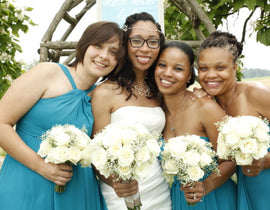
Consultant Picks: 5 Filler Flowers for Texture, Fullness & Personality

When you picture a beautiful flower arrangement, your eye probably goes first to the big blooms—the roses, peonies, dahlias, or other statement flowers that immediately grab attention. Look a little closer at a bouquet that feels especially layered, balanced, and thoughtfully designed, though, and you’ll see another group of flowers doing some very important work.
Filler flowers create connection, movement, texture, and fullness between the larger blooms in an arrangement.
For DIY designers, they can also make arranging much more forgiving. Instead of reaching for another large focal flower every time you see an opening, you can use smaller, more textural flowers to create dimension while still giving your statement blooms room to shine.
And filler flowers don't have to fade into the background. Some of our favorite choices bring plenty of personality of their own.
Here are five consultant-picked flowers worth considering when you want an arrangement to feel full, interesting, and anything but ordinary.
What Are Filler Flowers?
Filler flowers are typically smaller blooms or textural stems used throughout a bouquet or arrangement to complement focal flowers, create transitions, and add dimension.
Think of focal flowers as the stars of your arrangement. Filler flowers are part of the supporting cast that makes the entire design work.
They can soften noticeable openings between larger flowers, repeat color throughout a design, introduce a contrasting shape, or create movement around the edges of a bouquet. The result is an arrangement that feels layered instead of flat and intentionally designed rather than simply assembled.
If you're just starting to learn floral design, our guide to focal flowers, filler flowers, line flowers, and greenery is a helpful place to learn how these different ingredients work together. (fiftyflowers.com)
5 Consultant-Picked Filler Flowers We Love
Baby's breath may be one of the best-known filler flowers, but it's far from your only option. Choosing something less expected is an easy way to give a bouquet a more distinctive personality.
These five flowers are especially fun to consider when you're building texture into your design.

1. Nigella
If texture is your goal, Nigella Baby Blue Flowers immediately earn a place on the shortlist.
Nigella combines blooms with distinctive needle-like foliage, creating visual interest around the flower itself. FiftyFlowers describes the variety as adding texture to woodland-inspired arrangements, making it an intriguing choice when you don't want every element of your bouquet to have a smooth, rounded silhouette.
Consultant styling idea: Use Nigella where you want the outline of your arrangement to feel a little looser. Instead of burying every stem deep between larger blooms, allow some of that interesting shape and foliage to remain visible.

2. Tweedia
For something delicate with a very different flower shape, Soft Blue Designer Tweedia is a beautiful option.
Its small, star-shaped flowers appear along the stem, with blooms ranging from light blue to soft lavender. That combination of shape and color can bring another layer of detail to bouquets and centerpieces without simply adding another large, round bloom. (fiftyflowers.com)
Tweedia is also a good example of why filler flowers shouldn't automatically be hidden. Let some of those smaller flowers remain visible between and around your focal blooms so they become part of the overall design.
DIY note: Tweedia requires some specific handling because cut stems can release a sticky white sap. Follow the flower-care directions that accompany your order rather than treating it exactly like every other flower in your recipe. (fiftyflowers.com)

3. Feverfew Daisy
Feverfew Daisy brings a completely different personality to the mix.
Its small white petals and yellow centers create that unmistakable daisy look, and FiftyFlowers specifically identifies Feverfew as a versatile filler flower that's easy to work with for DIY designers as well as professionals.
This is one to consider when you want your flowers to feel cheerful, relaxed, or garden-inspired rather than overly formal.
Consultant styling idea: Don't concentrate all your Feverfew in one area. Try repeating small moments of it around the arrangement so your eye travels through the design.

4. Assorted Poppies
Here's where we can bend the traditional "filler flower" definition a little.
Assorted Poppies don't need to disappear into the background of an arrangement. In a mixed floral recipe, they can become expressive accent flowers that break up the shapes of your other blooms and add another layer of personality.
That distinction matters when you're planning DIY flowers: a flower doesn't always have to play one role.
Rather than worrying about whether every stem fits neatly into the category of focal, filler, line, or greenery, think about what the arrangement needs. You may choose a flower because it fills physical space, but you may also choose it because its shape, color, or placement creates an interesting transition between other ingredients.
Consultant styling idea: Treat poppies as accents rather than gap-fillers. Give individual blooms enough breathing room to be noticed.

5. Cornflowers
For another small bloom with plenty of character, consider cornflowers.
FiftyFlowers describes cornflowers as small, bright blooms with ball-like centers surrounded by frilly petals that form star-like florets. They sit on grass-like stems and may arrive with closed buds along the sprays, creating more than one visual element within a single ingredient.
That makes them especially interesting when you're trying to create an arrangement that feels collected rather than perfectly uniform.
Consultant styling idea: Let a few stems sit at slightly different heights instead of arranging all the flower heads on one level. Variation helps create the movement that makes a DIY bouquet feel more natural.
How Filler Flowers Create Fullness Without Looking Stuffed
There's a difference between an arrangement that looks full and one that looks stuffed.
A stuffed arrangement can feel like every available inch has been packed with flowers. A thoughtfully full arrangement still has depth, movement, and places for your eye to rest.
One of the easiest mistakes for a new designer is seeing a gap and immediately adding another large flower. Keep doing that, and you can quickly lose the shape and individuality of the flowers you've already placed.
Instead, look at the kind of space you're trying to solve.
Does the arrangement actually need more volume? Does it need a smaller flower to connect two larger blooms? Would a delicate stem extending outward create better movement? Or is that little pocket of negative space actually making your focal flowers look better?
That last question is especially important.
Not every gap needs to be filled.
A Simple DIY Technique for Better Filler Placement
Don't save all your filler flowers until the end and use them to cover mistakes. Build them into your arrangement as you go.
Start by establishing the general shape with greenery or other structural ingredients. Add several focal flowers, then begin weaving your filler and accent flowers between them.
Rotate the arrangement as you work. FiftyFlowers' DIY flower arrangement tutorial recommends working around the arrangement and turning it so you can see where additional stems are actually needed.
Then ask yourself three questions:
-
Where does one flower feel disconnected from the next?
-
Where could the arrangement use a different texture or smaller shape?
-
Where would a slightly taller or outward-reaching stem create movement?
Place filler with a purpose instead of automatically plugging every opening.
If you're making bouquets specifically, the step-by-step DIY wedding bouquet tutorial is a helpful companion guide for putting the complete arrangement together.
Consultant Pick: Don't Treat Filler Flowers as an Afterthought
Filler flowers may not always be the first flowers your guests notice, but they can be the reason the entire arrangement feels finished.
And as Nigella, Tweedia, Feverfew Daisy, poppies, and cornflowers show, "filler" doesn't have to mean generic or invisible.
Use these smaller and textural flowers to create connections between larger blooms, introduce unexpected shapes, repeat color, soften the outline of a bouquet, or add a little personality where the design needs it.
Most importantly, give yourself permission to experiment.
You don't need to know every floral design rule before you start. Choose focal flowers you love, select supporting flowers that bring something interesting to the recipe, and pay attention to how the ingredients relate to one another as you arrange.
Because filler flowers aren’t simply there to fill the gaps.They’re often what makes everything else feel like it belongs.
Ready to build your own floral recipe?
Start by choosing your focal flowers, then consider which of these consultant-picked blooms could bring the texture, color, movement, or personality your design is missing.
ABOUT THE AUTHOR


